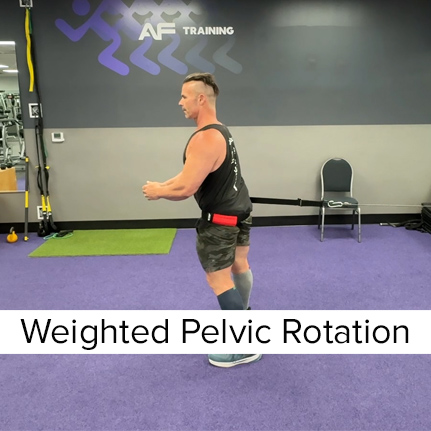
Weighted Pelvic Rotation with Upper Body Separation
I especially like this variation because the resistance is split between the hips and the upper body. The What's That Strap encourages the pelvis to initiate the movement, while the cable provides just enough resistance to the torso to make the golfer actively create and maintain separation. That combination makes it far more golf-specific than a standard cable rotation, where many athletes simply spin everything together. It reinforces the sequencing seen in skilled golfers—ground force into the lead leg, hips accelerating first, the torso following, and finally the arms and club delivering speed through impact.
For golfers who struggle with early extension, poor sequencing, or a lack of clubhead speed, this can be an outstanding drill to help bridge the gap between strength training and an efficient golf swing. It fits very well into a golf fitness program focused on increasing rotational power while improving movement quality.
Recommended Programming
- Warm-Up/Activation: 2 sets of 8 reps per side using a light dumbbell.
- Strength: 3–4 sets of 6–8 reps per side.
- Power: 3 sets of 5–6 explosive but controlled reps per side.
- Endurance/Stability: 2–3 sets of 10–12 reps per side.
Weighted Pelvic Rotation with Upper Body Separation Instructions
- Attach the What's That Strap to the cable machine.
- Facing away from the cable machine, step one leg in the loop and pulling it up to the top of your leg.
- Step forward slightly to get rid of any slack in the strap.
- Make one full 360-degree turn so the strap is wrapped around your hips.
- If the strap is around your right leg, you will turn to the left, and if the strap is around your left leg you will turn to the right.
- Take a couple steps away from the cable machine to create tension and stand in a golf posture with your feet approximately shoulder-width apart.
- Brace your core while maintaining a neutral spine.
- Initiate the movement by driving the hips toward the target.
- Allow the upper body to remain slightly behind the hips, creating separation.
- As the hips finish rotating, pause and feel the muscles in your glutes, abdominals, and lower back contracting to hold that position.
- Slowly return to the starting position under control.
- Repeat for the desired number of repetitions before switching directions.
Front View
Side View
Primary Muscles Used
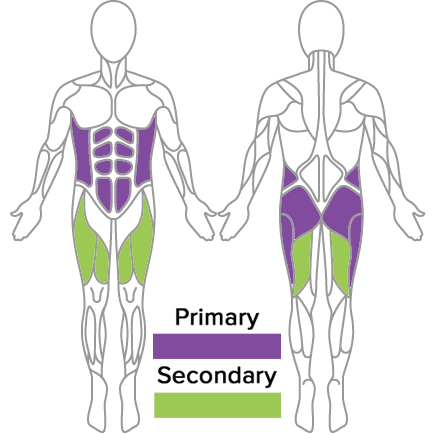
Tips
- Imagine your belt buckle starts the downswing.
- Keep your chest "quiet" as the hips begin moving.
- Feel the lead glute accepting your body weight.
- Stay tall through the hips.
- Rotate around a stable lead leg rather than sliding laterally.
- Exhale as you rotate to improve core activation.
- Think hips first, chest second, arms last.
Common Mistakes
- Rotating the shoulders and hips together: The hips should be the only thing moving, try to keep the upper body as stable as possible.
- Failing to shift pressure: Move pressure into the lead foot as the hips begin rotating.
- Losing posture: Keep your spine angle consistent throughout the exercise, neutral.
- Over-rotating the lumbar spine: Most of the rotation should come from the hips and thoracic spine, not the lower back.
- Allowing the knees to collapse inward: Maintain stable knee alignment and active glutes.
- Moving too quickly: Controlled acceleration is more valuable than simply moving fast.
Tim's list of benefits for the Weighted Pelvic Rotation with Upper Body Separation
- Develops Proper Downswing Sequencing: Trains the hips to initiate the movement while the torso and arms follow, improving the kinetic chain.
- Improves Hip-to-Shoulder Separation (X-Factor): Increases the stretch between the pelvis and upper body, helping generate greater clubhead speed.
- Builds Rotational Power: Strengthens the muscles responsible for explosive rotation through impact.
- Enhances Ground Force Production: Reinforces driving into the lead leg to create power from the ground up.
- Strengthens the Glutes and Hips: Improves stability and force production during the golf swing.
- Improves Weight Transfer: Teaches efficient pressure shift into the lead side for more consistent ball striking.
- Increases Core Stability: Challenges the core to resist premature rotation while maintaining posture.
- Improves Balance and Stability: Encourages better control throughout the entire rotational movement.
- Promotes Better Swing Mechanics: Reinforces the proper sequence of hips, torso, arms, and club for a more efficient swing.
- May Increase Clubhead Speed and Distance: Better sequencing and force transfer can lead to more powerful, consistent golf shots.
What if you could play the best golf of your life while looking and feeling your best? Green Physique's Golf Wellness program is an easy-to-use, expert-guided fitness program designed to help golfers of any skill level increase strength, mobility, stability, and flexibility.
Click here to go back to the full exercise list.