
As men get older, testosterone becomes an increasingly popular topic. We hear about declining testosterone, testosterone replacement therapy (TRT), “Low T,” declining muscle mass, decreased energy and the seemingly endless number of clinics promising to make men feel young again.
But there is another question that deserves considerably more attention:
Instead of immediately giving the body testosterone, can we encourage the body to produce more of its own?
That brings us to human chorionic gonadotropin, better known as hCG.
Most people associate hCG with pregnancy because it is produced in large quantities during pregnancy. However, hCG also has an interesting application in men. It can essentially imitate the activity of luteinizing hormone (LH), one of the signals responsible for telling the testes to produce testosterone.
That makes hCG fundamentally different from conventional testosterone replacement.
Instead of simply supplying testosterone from outside the body, hCG can stimulate the testes to produce testosterone internally.
That distinction is important.
How Men Normally Produce Testosterone
To understand hCG, we first need to understand how testosterone production normally works.
The process begins in the brain through what is known as the hypothalamic-pituitary-gonadal axis, or HPG axis.
The hypothalamus releases gonadotropin-releasing hormone (GnRH).
GnRH signals the pituitary gland to release two important hormones:
Luteinizing hormone (LH)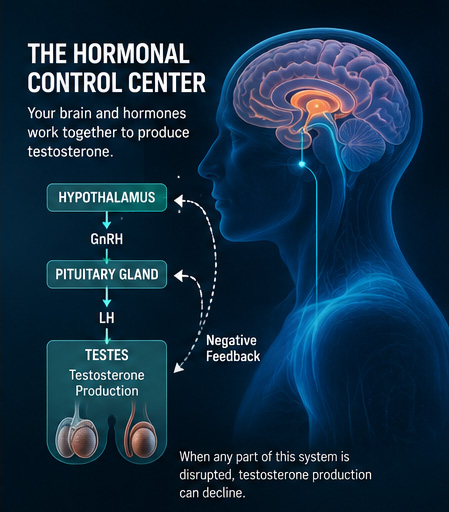
Follicle-stimulating hormone (FSH)
LH travels through the bloodstream to the testes, where it stimulates Leydig cells to produce testosterone.
It is a beautiful feedback system.
When testosterone levels become adequate, the brain receives feedback telling it to reduce stimulation. When testosterone levels fall, the system can increase its signaling.
At least, that is how the system is supposed to work.
Age, obesity, medications, chronic disease, sleep disorders and abnormalities involving the hypothalamus, pituitary or testes can interfere with this process. That is one reason simply seeing a low testosterone number doesn’t tell us why testosterone is low.
The Endocrine Society recommends diagnosing hypogonadism only when a man has appropriate symptoms together with consistently low testosterone measurements. It also recommends distinguishing between primary and secondary hypogonadism by evaluating LH and FSH.
That distinction becomes particularly important when considering hCG.
Where hCG Comes Into the Picture
hCG has biological activity similar to LH.
In a man whose testes remain capable of responding, hCG can bind to LH receptors on Leydig cells and stimulate those cells to produce testosterone.
In other words:
TRT provides testosterone.
hCG stimulates testosterone production.
That sounds like a subtle difference, but physiologically it can be substantial.
The American Urological Association describes hCG as an LH analogue that directly stimulates Leydig-cell testosterone production. There is also evidence demonstrating just how responsive the testes can remain later in life.
One randomized controlled study discussed in the AUA testosterone-deficiency guideline studied older men with androgen deficiency whose average age was approximately 67. Treatment with hCG produced approximately a 150% increase in total testosterone, demonstrating that older testes can retain considerable responsiveness to gonadotropin stimulation.
That is fascinating.
It suggests that in at least some older men, declining testosterone does not necessarily mean the testes have completely lost their ability to produce testosterone. Sometimes the signaling side of the system matters.
Can Your Mental State Affect Testosterone?
When we talk about maintaining healthy testosterone levels, the conversation usually revolves around exercise, body composition, sleep, nutrition 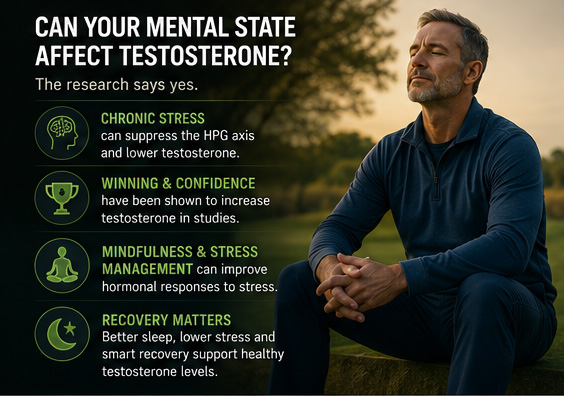 and eventually hormone therapy.
But there is another piece of the equation that is easy to overlook:
Your brain.
Testosterone production doesn’t occur in isolation. The testes are part of a much larger hormonal communication network involving the brain, pituitary gland, adrenal system and reproductive system.
That means our psychological environment particularly chronic stress can influence the hormonal environment in which testosterone is produced.
Stress and Testosterone: It’s More Complicated Than “Cortisol Is Bad”
You’ve probably heard someone say: “Stress raises cortisol, and cortisol kills testosterone.” That’s an oversimplification.
A 2024 systematic review and meta-analysis examined 21 studies involving 881 people exposed to acute psychological stress. Interestingly, acute stress tended to increase, rather than decrease, gonadal steroid activity, although responses varied substantially between studies.
Think about what happens before an important competition. Your heart rate increases. Your attention sharpens. Adrenaline rises. Your body prepares for a challenge. That short-term stress response isn’t necessarily unhealthy. In fact, it’s an important part of human physiology.
The bigger concern appears to be sustained stress.
A 2026 review examining stress-associated testosterone suppression concluded that prolonged physical and psychological stress can suppress signaling through the hypothalamic-pituitary-gonadal (HPG) axis. Severe energy deficits, inadequate sleep and persistent uncontrollable stress can interfere with GnRH and LH signaling and subsequently reduce testosterone production. Importantly, the researchers describe much of this suppression in stressed populations as potentially reversible rather than necessarily representing permanent testicular failure.
A separate 2026 review describes chronic psychological stress and accumulated “allostatic load”—essentially the wear and tear created by persistent stress as contributing to endocrine dysregulation that can be associated with testosterone suppression.
That distinction is extremely important.
Sometimes Low Testosterone May Be Part of a Bigger Picture
Imagine someone who is:
- sleeping five hours a night,
- constantly worried about work,
- training hard without recovering,
- eating poorly,
- gaining abdominal fat,
- and living in a constant state of psychological stress.
Then his bloodwork comes back showing low testosterone.
Is the problem simply that his body needs more testosterone? Or is low testosterone one piece of a much larger physiological environment?
That doesn’t mean stress reduction will magically correct clinically significant hypogonadism.
But it does give us another reason to investigate why testosterone is low before automatically deciding how to raise it.
What About Confidence, Winning and Competition?
Here’s where the research becomes particularly interesting for athletes and golfers.
Testosterone appears to respond not only to physical conditions but also to our competitive environment.
A large meta-analysis examined more than 2,500 participants and found that competition winners experienced greater increases in testosterone than losers. The effect was especially apparent in real-world competitive settings such as sports rather than laboratory competitions.
That’s not the same as saying:
“Think like a winner and you’ll increase your testosterone.”
The biology isn’t nearly that simple.
But it demonstrates something fascinating:
Our psychological and social experiences can interact with our endocrine system.
Research in competitive tennis players provides an interesting example. Testosterone generally increased before competition, and players with higher pre-match testosterone showed more positive changes in mood. After competition, winners tended to show increasing testosterone relative to losers, particularly when the winners felt positively about how they had performed.
Other experimental research has also found significantly higher post-competition testosterone among male winners compared with losers, with changes in mood potentially playing a role.
Again, context matters enormously. Competition research is heterogeneous, and experiments attempting to artificially manufacture “confidence” such as simply adopting so-called power poses have failed to show a reliable overall testosterone increase.
You can’t fake your way to higher testosterone by standing differently in front of the mirror.
But the broader mind-body relationship is real.
In over 20 years of experience working with athletes and non-athletes, I have seen a direct correlation, when people have a competitive, winning attitude, their testosterone always is higher than someone of the same age who is not a “winner”. The question is; “Does the winning attitude produce the higher testosterone, or does the naturally higher testosterone produce the winning attitude?”
Where Mindfulness Gets Interesting
This brings us to something I find especially interesting: mindfulness and stress management.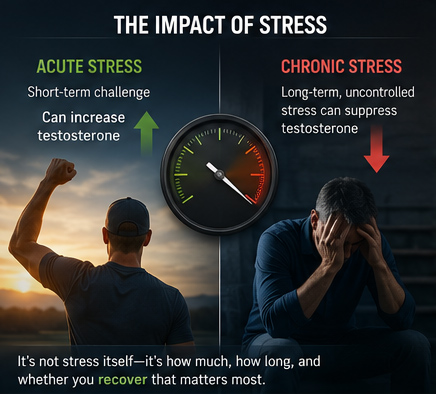
A 2024 randomized pilot study investigated young men undergoing acute psychological stress. Participants completed seven 20-minute sessions of either mindfulness meditation or relaxation training.
Acute stress initially increased both cortisol and testosterone.
After the stress exposure, however, the mindfulness group demonstrated a different hormonal response: testosterone was higher following the additional mindfulness practice compared with the relaxation group, while cortisol increased more in the relaxation group.
That’s intriguing.
But let’s be careful with the conclusion.
This study does not prove that meditation increases your everyday testosterone level.
It was a small pilot study examining the hormonal response to acute stress, not a long-term treatment for low testosterone.
What it does demonstrate is that psychological interventions can potentially influence the hormonal response to stress.
And that makes sense when we stop treating the mind and body as completely separate systems.
The Golfer Connection
This becomes particularly relevant on the golf course.
Golf can create a fascinating psychological environment.
One minute you’re relaxed and playing beautifully. Then you hit one bad shot. You start thinking about the last hole. You worry about the next shot. Your breathing changes. Muscular tension increases. Your attention shifts.
Suddenly you’re no longer simply playing golf, you’re battling your own physiological stress response.
This is one reason I believe mental training deserves a legitimate place alongside strength, mobility, nutrition and recovery in a complete golf-performance program.
The goal isn’t to eliminate stress.
The goal is developing the ability to respond appropriately to stress and then return to baseline.
That’s useful on the golf course.
It’s useful in the gym.
And it’s probably useful for long-term health as well.
The Holistic Golfer Takeaway
There is no evidence that simply “thinking positively” will magically transform a man’s testosterone level.
That’s not what the science says.
What the research does tell us is much more interesting:
The brain, stress response and reproductive hormone system communicate with one another.
Acute challenges can temporarily alter testosterone. Competition outcomes can influence testosterone responses. Chronic psychological and physiological stress can contribute to an environment associated with suppressed testosterone. And emerging research suggests that interventions designed to manage stress may influence some of these hormonal responses.
So when evaluating low testosterone, I don’t think we should look only at the testes.
Look at the whole person.
How is he sleeping?
How is he eating?
How is he training?
How is his body composition?
How well is he recovering?
And what is happening between his ears?
None of those questions replaces appropriate medical testing or treatment when it’s needed.
But they remind us of something that sits at the heart of the Holistic Golfer philosophy:
The mind and body aren’t separate systems. They’re different parts of the same golfer.
hCG vs. Testosterone Replacement Therapy
This is where the comparison becomes particularly interesting.
TRT is effective precisely because it bypasses the body’s testosterone-production system.
A man receives testosterone externally through injections, gels, patches or other preparations, and circulating testosterone increases.
For men with properly diagnosed hypogonadism, TRT can provide meaningful benefits. The Endocrine Society recognizes improvements involving sexual symptoms, muscle, bone health and anemia in appropriately selected patients.
But there is a trade-off.
The brain detects the testosterone entering the bloodstream and essentially says:
We have plenty of testosterone. We don’t need to make as much.
LH and FSH can subsequently decline.
Testicular testosterone production decreases.
Sperm production can decrease dramatically and sometimes cease.
That is why major medical guidelines recommend against testosterone monotherapy in men actively interested in maintaining fertility.
hCG approaches the problem differently.
Rather than bypassing the testes, hCG stimulates them.
That means endogenous testosterone production can increase while intratesticular testosterone, the very high concentration of testosterone inside the testes required for normal sperm production is better maintained.
For a younger man concerned about fertility, that difference can be extremely important.
Potential Advantages of hCG
1. It Stimulates Your Own Testosterone Production
This is the most interesting aspect of hCG.
Rather than simply replacing testosterone, hCG stimulates functioning Leydig cells to produce it.
That doesn’t automatically make hCG superior to TRT, but physiologically it represents a very different approach.
2. Fertility Can Be Better Preserved
This is probably the strongest argument for hCG over testosterone in appropriate men.
Exogenous testosterone suppresses gonadotropin production and can substantially suppress spermatogenesis.
The AUA/ASRM guideline allows clinicians to consider hCG, SERMs or aromatase inhibitors in infertile men with low testosterone because these approaches can increase endogenous testosterone without the same suppression of spermatogenesis associated with testosterone monotherapy.
A review of hCG treatment similarly concluded that its ability to stimulate testosterone and sperm production makes it particularly interesting for men with secondary hypogonadism who wish to maintain fertility.
3. It Maintains Testicular Function
This receives much less attention in mainstream discussions about TRT.
There is a major physiological difference between having an organ continue doing its job and bypassing that organ by supplying its end product.
hCG maintains stimulation of the testes.
This can help maintain intratesticular testosterone and testicular activity.
4. Testosterone Can Increase Substantially
hCG isn’t merely a fertility medication that happens to affect testosterone.
Increasing testosterone is part of its biological action.
Research in older men demonstrates that substantial testosterone increases can occur when the testes remain responsive.
Small observational studies of hCG monotherapy have also reported improvements in symptoms such as libido and erectile function, although these studies are much too small to establish that hCG provides the same long-term clinical benefits as established testosterone therapy.
Where the Argument for hCG Has Limits
This is where we have to resist turning an interesting therapy into another miracle hormone treatment.
hCG doesn’t work equally well for every type of low testosterone.
Consider two very different scenarios.
In secondary hypogonadism, the hypothalamus or pituitary isn’t providing adequate stimulation, but the testes themselves may still be capable of producing testosterone.
Giving an LH-like signal through hCG makes physiological sense.
In primary hypogonadism, however, the testes themselves are failing.
LH may already be elevated because the brain is essentially shouting at the testes:
MAKE MORE TESTOSTERONE!
If they can’t respond adequately to the body’s own LH, giving another LH-like signal may accomplish relatively little.
The AUA/ASRM guideline specifically notes that men with elevated LH, suggesting primary hypogonadism, can have a limited testosterone response to hCG or similar approaches.
That is why proper testing matters.
Potential Risks and Downsides
Natural testosterone production does not mean risk-free treatment.
hCG is a powerful hormonal medication.
Because increased testosterone can also mean increased conversion of testosterone into estradiol, estrogen-related effects can occur.
Possible adverse effects associated with hormonal manipulation can include acne, fluid retention, breast tenderness or enlargement, mood changes and changes in hormone balance.
Response also varies considerably between individuals.
And unlike TRT, which has been studied extensively, the evidence surrounding long-term hCG monotherapy for ordinary age-associated testosterone decline remains comparatively limited.
The AUA specifically describes the overall quantity and quality of evidence surrounding alternative testosterone therapies such as hCG as limited.
That deserves emphasis.
Promising is not the same thing as proven.
What About Using hCG Once a Year to “Recharge” Testosterone?
This is where I think we need to separate an intriguing idea from an established medical strategy.
You will occasionally hear the concept that a man could periodically use hCG to stimulate his testes and essentially give testosterone production an annual boost.
Physiologically, the idea sounds appealing.
But we currently don’t have good clinical evidence demonstrating that an otherwise healthy aging man can undergo an annual hCG “cycle,” discontinue treatment and consequently maintain significantly higher testosterone for the remainder of the year.
hCG stimulates testosterone production while providing an LH-like stimulus.
That doesn’t mean a temporary course permanently rejuvenates the HPG axis or reverses normal aging.
Therefore, I would not currently recommend an annual hCG cycle as an evidence-based anti-aging strategy.
And while this is not an established treatment option for men, I feel that for most men with low testosterone, looking at TRT, this is a much safer, more natural, and ultimately more effective way to increase testosterone levels. But, to use this kind of therapy, you have to have a doctor who is willing to look outside the conventional box, and work with you. You also have to be educated and know what it is you are asking for, and make sure you understand how to read your lab reports, or find someone who can help you read and understand them.
Could hCG Be a Better Option Than TRT?
For some men, I think the scientific case for considering hCG before automatically moving to lifelong testosterone replacement is compelling.
But the words “for some men” are critical.
If a man has secondary hypogonadism, functioning testes and particularly an interest in maintaining fertility, stimulating endogenous testosterone production has obvious theoretical and clinical advantages.
The AUA recognizes hCG as an option for testosterone-deficient men wishing to maintain fertility.
TRT, however, remains an established therapy for appropriately diagnosed hypogonadism, and there are men whose underlying physiology makes testosterone replacement considerably more logical than trying to stimulate testes that cannot adequately respond.
So I wouldn’t describe hCG as universally “better than testosterone.”
I’d say something slightly different:
Before automatically replacing testosterone, shouldn’t we first ask whether the body is still capable of producing more of its own?
I think that’s the more interesting conversation.
The Problem With Going Straight to TRT
One of my concerns with the current testosterone boom isn’t that testosterone replacement therapy is inherently bad. For a man with properly diagnosed hypogonadism, TRT can be an effective and medically appropriate treatment.
My concern is going straight from “your testosterone is low” to “let’s put you on testosterone” without adequately investigating why it is low in the first place.
That distinction matters because taking testosterone from outside the body changes the body’s normal hormonal signaling.
Normally, the hypothalamus and pituitary communicate with the testes through the hypothalamic-pituitary-gonadal (HPG) axis. The pituitary releases luteinizing hormone (LH), which tells the Leydig cells in the testes to produce testosterone, while follicle-stimulating hormone (FSH) plays an important role in sperm production.
When testosterone is supplied from outside the body, the brain detects the increased circulating testosterone and responds through negative feedback.
The message is essentially:
“We have enough testosterone. Reduce production.”
LH and FSH can consequently fall.
With less LH stimulation, the testes produce less testosterone themselves. With reduced gonadotropin signaling, sperm production can also decline substantially.
This isn’t controversial. It is basic reproductive endocrinology.
The American Urological Association and American Society for Reproductive Medicine specifically warn that exogenous testosterone can inhibit gonadotropin secretion. Depending upon the degree of suppression, sperm production may decrease dramatically or even stop. For that reason, their guideline states that clinicians should not prescribe exogenous testosterone to men interested in current or future fertility.
TRT Can Raise Testosterone While Suppressing Testosterone Production
This sounds contradictory, but it is an incredibly important distinction:
TRT can increase the testosterone measured in your bloodstream while simultaneously decreasing the amount of testosterone your testes are producing naturally.
Your blood test may look fantastic.
But some of that testosterone is now coming from the medication rather than your body’s own production.
That doesn’t automatically make TRT bad. If a man’s testes cannot produce adequate testosterone because of primary hypogonadism, replacing the missing hormone can make perfect physiological sense.
But what if the testes can still function?
That’s where I believe a more thorough investigation should occur before automatically choosing replacement.
Are We Always Doing That Investigation?
Apparently not.
Research presented at the Endocrine Society’s ENDO 2026 meeting examined 200 men receiving an initial testosterone prescription between 2020 and 2025. Only 12% had documentation of two low morning testosterone measurements, LH and/or FSH testing, and absence of contraindications—the components the researchers used to assess guideline-concordant diagnostic testing.
That doesn’t mean 88% of these men shouldn’t have received testosterone. Nor does one retrospective study tell us how every physician practices.
But it does raise an important question:
Are some men being prescribed testosterone before we have adequately determined why their testosterone is low?
The Endocrine Society recommends something more thorough: symptoms consistent with testosterone deficiency, consistently low testosterone measurements, repeat morning testing, and further evaluation to determine the cause. It also recommends measuring LH and FSH to distinguish primary testicular hypogonadism from secondary hypothalamic/pituitary hypogonadism.
That diagnostic distinction could completely change the conversation.
Primary vs. Secondary Hypogonadism
Imagine two men whose bloodwork shows exactly the same testosterone level.
Man #1: His brain is producing plenty of LH, but his testes aren’t responding adequately.
That suggests primary hypogonadism. His testes themselves may be the limiting factor, making testosterone replacement a logical treatment when clinically indicated.
Man #2: His testosterone is low and his LH is low or inappropriately normal.
Now we have a different situation.
His testes may retain the ability to produce testosterone but aren’t receiving adequate stimulation.
That doesn’t automatically mean hCG is the answer—the underlying cause still needs to be investigated—but it demonstrates why simply looking at total testosterone doesn’t tell the entire story.
The AUA/ASRM guideline recognizes this distinction. It notes that hCG acts as an LH analogue and directly stimulates Leydig cells to produce testosterone. It also notes that men with elevated LH consistent with primary hypogonadism may respond poorly to hCG because the underlying problem is testicular dysfunction.
Why I Think This Conversation Matters
There is an important difference between replacing something the body can no longer adequately produce and replacing something without first determining why production has fallen.
Before beginning long-term hormonal treatment, I believe a better question is:
Why isn’t this man’s body producing enough testosterone?
Could excess body fat be contributing?
Poor sleep?
Sleep apnea?
Certain medications?
Metabolic disease?
A pituitary problem?
Primary testicular dysfunction?
Or another medical condition?
The Endocrine Society reiterated this point in July 2026, specifically recommending that clinicians rule out potentially reversible contributors such as obesity and certain medications before moving forward. For appropriately diagnosed hypogonadism associated with overweight or obesity without another identified cause, it identifies weight loss as typically the first-line treatment.
TRT Isn’t the Villain
I want to be very clear about this.
TRT isn’t the villain. Poor diagnosis is the problem.
There are men for whom testosterone replacement is absolutely appropriate, and properly prescribed TRT can provide meaningful benefits.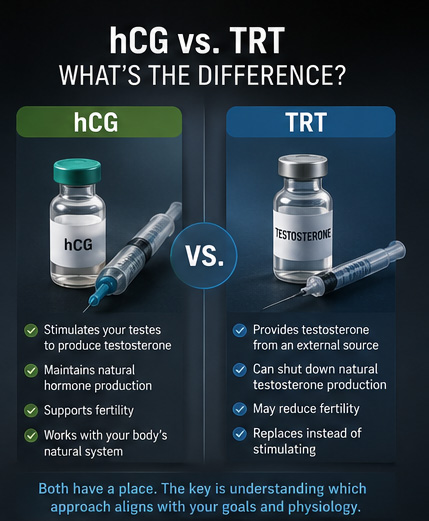
But giving testosterone from outside the body is not the same thing as restoring natural testosterone production.
Exogenous testosterone can suppress LH and FSH signaling and therefore suppress endogenous testicular testosterone production and sperm production.
That’s precisely why I find treatments such as hCG so interesting in appropriately selected men.
Rather than automatically asking:
“How do we replace this man’s testosterone?”
perhaps the first question should sometimes be:
“Why is his testosterone low—and is his body still capable of producing more of its own?”
Only after answering that question can we have an intelligent conversation about whether lifestyle intervention, treatment of an underlying condition, hCG, TRT or another physician-directed approach makes the most sense.
Don’t Treat the Number, Find Out Why the Number Is Low
This may be the most important lesson in the entire testosterone discussion.
Suppose a 55-year-old man discovers that his testosterone is low.
Why?
Is he sleeping five hours per night?
Does he have untreated sleep apnea?
Is he obese?
Is he chronically under-recovering?
Is he taking a medication that suppresses testosterone?
Is there a pituitary problem?
Are his LH and FSH low?
Or are LH and FSH already elevated because the testes aren’t responding?
Those situations should not automatically receive identical treatment.
The Endocrine Society continues to emphasize this point. In a 2026 statement, it reiterated that testosterone deficiency should be diagnosed from both symptoms and consistently low, accurately measured testosterone, while potentially reversible contributors such as obesity and certain medications should be investigated.
I love this approach because it fits into a broader philosophy of health:
Don’t just chase the laboratory number. Ask why the number changed.
Sleep better.
Improve body composition.
Exercise.
Strength train.
Correct nutritional deficiencies when they exist.
Reduce excessive alcohol consumption.
Address metabolic health.
Manage stress.
Then, if testosterone remains genuinely deficient and symptoms remain, work with a knowledgeable physician to determine where the hormonal system is failing.
The Holistic Golfer Evidence Scorecard: hCG vs. TRT vs. Lifestyle
| Category | hCG | TRT | Lifestyle |
|---|---|---|---|
| Ability to raise testosterone | ⭐⭐⭐⭐ | ⭐⭐⭐⭐⭐ | ⭐⭐⭐ |
| Stimulates natural testosterone production | ⭐⭐⭐⭐⭐ | ⭐⭐⭐⭐ | |
| Preserves fertility | ⭐⭐⭐⭐½ | ⭐⭐⭐⭐⭐ | |
| Maintains testicular function | ⭐⭐⭐⭐⭐ | ⭐⭐⭐⭐⭐ | |
| Evidence for treating diagnosed low T | ⭐⭐⭐ | ⭐⭐⭐⭐⭐ | ⭐⭐⭐⭐* |
| Evidence for age-related optimization | ⭐⭐ | ⭐⭐⭐ | ⭐⭐⭐⭐* |
| Long-term research | ⭐⭐½ | ⭐⭐⭐⭐⭐ | ⭐⭐⭐⭐⭐ |
| Reversibility / avoiding long-term hormone dependence | ⭐⭐⭐⭐ | ⭐⭐ | ⭐⭐⭐⭐⭐ |
| Addresses underlying lifestyle causes | ⭐ | ⭐ | ⭐⭐⭐⭐⭐ |
| Requires medical supervision | YES | YES | Usually no |
| Overall for the right patient | ⭐⭐⭐⭐ | ⭐⭐⭐⭐½ | ⭐⭐⭐⭐⭐ |
*Lifestyle earns its strongest score when low testosterone is associated with a reversible factor such as excess body fat, poor metabolic health, inadequate recovery, medication effects or another modifiable cause—not when someone has irreversible primary testicular failure. The Endocrine Society specifically emphasizes investigating reversible causes and, in its July 2026 statement, identifies weight loss as first-line therapy when appropriately diagnosed hypogonadism is associated with overweight/obesity and no other cause is identified.
🏆 The Holistic Golfer Verdict
Lifestyle — Best Foundation ⭐⭐⭐⭐⭐
Before manipulating hormones, determine why testosterone is low. Sleep, resistance training, healthy body composition, nutrition, metabolic health and treatment of underlying problems should form the foundation whenever relevant. Lifestyle won’t correct every form of hypogonadism, however.
hCG — Most Interesting Alternative ⭐⭐⭐⭐
hCG gets my highest marks for its mechanism. It mimics LH activity and stimulates the testes rather than simply supplying testosterone from outside the body. That’s especially important when fertility and continued testicular function matter. The AUA/ASRM guideline allows hCG in infertile men with low testosterone and specifically advises against testosterone monotherapy when current or future fertility is desired.
The major deduction is evidence depth. Research on long-term hCG monotherapy is considerably thinner than the evidence for TRT, and small observational studies shouldn’t be mistaken for proof of long-term superiority.
TRT — Strongest Established Hormonal Treatment ⭐⭐⭐⭐½
TRT wins decisively for the amount of clinical evidence supporting its ability to restore testosterone in appropriately diagnosed hypogonadal men. The Endocrine Society recommends testosterone therapy for men with symptomatic, confirmed testosterone deficiency when appropriate.
Its major disadvantage for this scorecard is physiological: external testosterone suppresses the reproductive axis and sperm production, making it a poor choice when fertility is a near-term priority.
The Holistic Golfer Takeaway
There is a tendency in modern health care and especially in the world of performance and anti-aging—to look at a laboratory number and immediately ask:
“What can we take to change it?”
I think we should ask another question first:
“Why did it change?”
If testosterone is low because the testes can no longer adequately produce it, replacement may be entirely appropriate.
If testosterone is low because of obesity, poor metabolic health, inadequate sleep, medication effects or another reversible factor, addressing the underlying problem may be the better first step.
And if the testes remain functional but aren’t receiving adequate hormonal stimulation, therapies that stimulate endogenous testosterone production may deserve consideration under appropriate medical supervision.
That’s the holistic approach.
It isn’t natural versus pharmaceutical.
It isn’t hCG versus TRT.
And it certainly isn’t about rejecting conventional medicine.
It’s about understanding the entire system before deciding which part of that system needs intervention.
One Final Thought
hCG is fascinating. TRT can be extremely valuable. Lifestyle matters enormously.
But none of them should be chosen because they’re popular on social media or because someone at the gym swears by them.
Test. Investigate. Understand the cause. Then treat appropriately.
That’s a much better approach to men’s health and to staying strong, capable and on the golf course for decades to come.
My Final Thoughts
I find hCG fascinating because it represents a different philosophy from simply replacing testosterone.
Rather than saying:
“Your testosterone is low, so let’s give you testosterone,”
it allows us, in appropriate circumstances, to ask:
“Can we get your body producing more testosterone itself?”
That doesn’t make hCG natural, harmless or appropriate for everyone. It is a prescription hormone requiring proper medical evaluation and monitoring.
And while current evidence does not justify recommending an annual hCG cycle to healthy aging men simply to keep testosterone elevated.
But for certain men especially those with secondary hypogonadism and men concerned about maintaining fertility, hCG gives physicians another legitimate option.
That’s why I think the future of men’s hormone health shouldn’t simply be a debate between TRT or no TRT.
A better question is:
Why is testosterone low, and what is the most physiologically appropriate way to address the cause?
Sometimes testosterone replacement may be the answer.
Sometimes lifestyle modification may be the answer.
And in carefully selected men, stimulating the body’s own testosterone production with hCG may deserve serious consideration before simply replacing the hormone.
The Holistic Golfer examines nutrition, fitness, recovery, supplementation and health through the combination of scientific evidence, practical experience and a whole-body approach. This article is educational and is not intended to diagnose or treat a medical condition. hCG and testosterone are prescription medications and should only be used under the supervision of a qualified medical professional.
Before You Go — Don’t Skip the References
If you’ve read other articles from The Holistic Golfer, you know I don’t like treating the references section as something we throw at the bottom of an article simply to make it look scientific.
On a subject like testosterone, hCG and hormone replacement, I think the references may be some of the most important reading on this entire page.
There is an enormous amount of information—and misinformation—surrounding testosterone online. You’ll find people who believe every aging man should be on TRT, people who believe nobody should be on TRT, clinics promising to “optimize” your hormones, and influencers promoting protocols that are far ahead of the actual research.
The truth is considerably more nuanced.
So don’t just take my word for it.
Keep reading. Look at the evidence. Ask questions. And most importantly, understand the difference between what research has actually demonstrated and what simply sounds good in theory.
Continued Reading & Scientific References
Endocrine Society — Testosterone Therapy in Men With Hypogonadism
One of the best places to begin. The Endocrine Society’s clinical practice guideline explains how testosterone deficiency should be diagnosed, why repeat morning testosterone measurements matter, how physicians distinguish primary from secondary hypogonadism, and when testosterone therapy may or may not be appropriate.
Why I included it:
Before debating hCG versus TRT, we first need to establish what responsible diagnosis of testosterone deficiency actually looks like.
Read the Endocrine Society guideline
Endocrine Society — 2026 Statement on Testosterone Replacement Therapy
This is particularly valuable because it provides a very current perspective on testosterone therapy. The Endocrine Society emphasizes confirming true testosterone deficiency and investigating potentially reversible contributors rather than treating a laboratory number in isolation.
Why I included it:
It reinforces one of the central messages of this article:
Before asking how to raise testosterone, ask why testosterone is low.
Read the Endocrine Society’s 2026 statement
American Urological Association / ASRM — Male Infertility Guideline
This guideline is particularly useful for understanding the fertility side of testosterone treatment.
It discusses how exogenous testosterone can suppress gonadotropin secretion and impair sperm production, while medications including hCG can be considered in appropriate men with low testosterone who wish to preserve fertility.
Why I included it:
This is one of the strongest pieces of evidence supporting the distinction I have emphasized throughout this article:
Replacing testosterone and stimulating testosterone production are not physiologically the same thing.
Read the AUA/ASRM Male Infertility Guideline
American Urological Association — Testosterone Deficiency Guideline
The AUA guideline provides another comprehensive medical perspective on diagnosis and treatment of testosterone deficiency.
It also discusses alternative strategies for men interested in maintaining fertility, including hCG.
Why I included it:
This is an excellent resource for anyone who wants to understand where hCG actually fits within mainstream urological medicine rather than viewing it simply as an “alternative” hormone treatment.
Read the AUA Testosterone Deficiency Guideline
hCG Monotherapy for Men With Low Testosterone
Clinical research examining hCG as monotherapy is particularly interesting because it asks the question at the center of this article:
Can we increase testosterone by stimulating the testes rather than simply supplying testosterone externally?
Small studies have reported increases in testosterone and improvements in some symptoms, but the research base remains much smaller than the evidence supporting conventional TRT.
Why I included it:
It demonstrates both sides of the hCG story. There is legitimate science behind its ability to stimulate testosterone production, but we shouldn’t pretend that the long-term evidence is as extensive as it is for TRT.
Endocrine Society — Are Men Being Properly Evaluated Before TRT?
Research presented at ENDO 2026 examined how closely testosterone prescribing followed recommended diagnostic evaluation.
The findings raise important questions about whether some men receive testosterone before a complete evaluation of the underlying cause of their low testosterone.
Why I included it:
It supports an important distinction:
The problem isn’t TRT. The problem is using TRT without first understanding the patient.
Read about the ENDO 2026 research
Acute Psychological Stress and Sex Hormones — 2024 Systematic Review & Meta-Analysis
This systematic review and meta-analysis examined 21 studies involving 881 participants to determine how acute psychological stress affects gonadal steroid hormones.
Interestingly, the researchers found that acute psychosocial stress tended to increase gonadal steroid activity, demonstrating why the common statement that “stress lowers testosterone” is too simplistic.
Why I included it:
It helps us distinguish between short-term stress and chronic stress. The body’s immediate response to a challenge can be very different from what happens when someone lives under persistent stress.
Stress-Associated Testosterone Suppression — 2026 Review
This recent review examines testosterone suppression associated with physiological and psychological stress and the interaction between the stress system and the hypothalamic-pituitary-gonadal axis.
The authors discuss how factors including chronic stress, inadequate sleep and energy deficiency can interfere with the signaling responsible for normal reproductive hormone production.
One particularly interesting aspect is the concept that testosterone suppression associated with these conditions can sometimes represent a functional and potentially reversible adaptation, rather than permanent failure of the testes.
Why I included it:
This supports one of the most important ideas in this entire article:
Low testosterone is a finding. It doesn’t automatically tell us why testosterone is low.
Chronic Stress, Allostatic Load and Testosterone — 2026 Review
This review explores the relationship between chronic psychological stress, accumulated physiological stress—or allostatic load—and male reproductive hormones.
Allostatic load is an important concept because it moves the conversation beyond a single stressful afternoon. It describes the cumulative physiological burden created when the body’s stress-response systems are repeatedly or continuously activated.
Why I included it:
When discussing testosterone and longevity, I think chronic stress exposure is considerably more meaningful than simply labeling cortisol as “bad.”
Winning, Losing and Testosterone — Meta-Analysis
This meta-analysis examined the relationship between testosterone and competitive outcomes across research involving more than 2,500 participants.
Overall, winners demonstrated greater increases in testosterone than losers, with particularly interesting effects occurring in real-world competitive environments such as sports.
Why I included it:
This research demonstrates that testosterone isn’t responding only to food, exercise and medication. Competition and our psychological/social environment can interact with our endocrine system as well.
That’s particularly interesting when we’re talking about golfers and other competitive athletes.
Testosterone, Mood and Competition in Tennis Players
This classic study examined testosterone and psychological responses surrounding competitive tennis matches.
Testosterone generally increased before competition, and higher pre-match testosterone was associated with more positive mood changes. Following competition, winners and losers also demonstrated different testosterone responses.
Why I included it:
Golf and tennis have something important in common: they’re highly technical sports in which an athlete’s psychological state can profoundly affect performance.
This doesn’t prove that confidence itself increases testosterone, but it provides another fascinating example of the interaction between competition, mood and hormonal physiology.
Winning a Competition and Testosterone Response
Researchers studying male competition found significantly different post-competition testosterone responses between winners and losers, with psychological reactions to the outcome potentially contributing to the hormonal response.
Why I included it:
It reinforces the idea that the endocrine system isn’t operating independently from our experiences. What happens psychologically during competition can be accompanied by measurable physiological changes.
Mindfulness, Acute Stress, Cortisol and Testosterone — 2024 Randomized Pilot Study
This study is particularly interesting.
Young men underwent an acute psychological stressor after completing seven sessions of either mindfulness meditation or relaxation training.
Both cortisol and testosterone initially responded to the stressor. Following additional mindfulness practice, however, researchers observed differences in the subsequent hormonal response between the groups, including differences involving both testosterone and cortisol.
Why I included it:
This does not establish mindfulness as a treatment for low testosterone.
What it does show is something much more scientifically reasonable: how we manage psychological stress may influence our physiological response to that stress.
For anyone interested in the relationship between mental performance and physical health, this is fascinating research.
Stress-Management Interventions and Cortisol — Systematic Review & Meta-Analysis
This large systematic review and meta-analysis included 58 studies and 3,508 participants and examined psychological interventions designed to manage stress.
Interventions included mindfulness and meditation, relaxation techniques, mind-body approaches and other psychological therapies. Overall, stress-management interventions produced meaningful effects on cortisol compared with control conditions.
Why I included it:
This isn’t direct evidence that stress management raises testosterone—and I don’t want to imply that it is.
Instead, it provides stronger evidence for the first half of the equation: psychological interventions can measurably influence the body’s physiological stress system.
That gives us another reason to take stress management seriously as part of an overall health and longevity strategy.