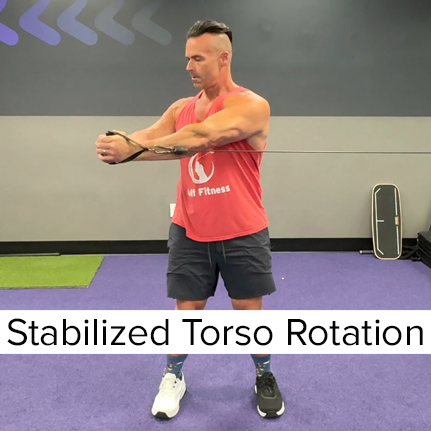
Lower-Body Stabilized Torso Rotation
Anyone can rotate; great golfers learn how to control where that rotation comes from. This exercise challenges you to keep your hips and arms quiet while your torso does the work, building the separation and abdominal control needed for an efficient golf swing.
Recommended Programming
Golf warm-up / movement preparation: 1–2 sets × 6–10 controlled reps per side
Golf performance training: 2–3 sets × 8–12 reps per side
Lower-Body Stabilized Torso Rotation Instructions
- Set a cable approximately at mid-torso/chest height.
- Stand perpendicular to the cable machine in an athletic golf-like stance.
- Hold the handle with both hands and extend the arms comfortably in front of the body.
- Establish a stable base through the feet, knees and pelvis.
- Brace the abdominal wall lightly before beginning.
- Rotate the torso away from the cable while keeping the pelvis as quiet as possible.
- Keep the arms relatively fixed in relation to the torso. The arms should travel because the torso is rotating, rather than pulling the cable across the body.
- Slowly return to the starting position while maintaining the same lower-body stability.
- Complete the repetitions and repeat in the opposite direction.
Side View
Front View
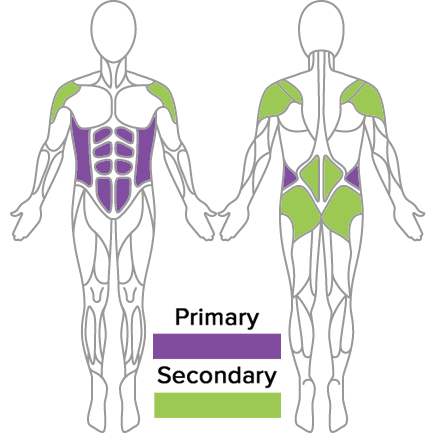
Primary Muscles Used
Tips
- Watch your hips: Your belt buckle should stay facing essentially the same direction throughout the movement. If it begins turning with you, reduce the resistance or range of motion.
- Watch your hands: Your hands should maintain roughly the same relationship to the center of your chest. If the arms are sweeping independently across your body, you're probably using too much shoulder and arm movement.
- Pay attention to where you feel it: You should primarily feel your abdominal and oblique muscles controlling the rotation—not your arms doing all the work.
- Check your weight distribution: You shouldn't need to dramatically shift from one foot to the other to complete the rotation.
- Compare both directions: Notice whether rotating one way is significantly easier, smoother, or provides more range than the other.
- Don't judge the exercise by how far you rotate: A smaller amount of clean torso rotation with stable hips is better than a large rotation created by moving everything together.
- Use a mirror when possible: This is an excellent exercise to perform in front of a mirror because you can immediately see whether your pelvis is beginning to rotate.
- Lower the weight if your form changes: If adding resistance causes your hips, arms, or shoulders to take over, the cable is too heavy for the purpose of this exercise.
Common Mistakes
- Rotating the hips — probably the biggest mistake. Once the pelvis starts following the torso, much of the separation component disappears.
- Pulling with the arms — the hands shouldn't simply drag the cable across the body.
- Overusing the shoulders — excessive shoulder movement can make it look like there's more torso rotation than there actually is.
- Using too much weight — heavy resistance almost automatically encourages compensation from the hips, shoulders and arms.
- Shifting body weight excessively — the golfer should maintain a relatively centered, stable base.
- Straightening or bending the knees during the movement — changing lower-body position can help manufacture rotation.
- Losing abdominal control — particularly allowing the ribs to flare or the lower back to extend.
- Moving too quickly — momentum defeats much of the purpose of the exercise.
- Chasing range of motion — I'd rather see a smaller amount of true torso rotation than a larger movement created through compensation.
Tim's list of benefits for the Lower-Body Stabilized Torso Rotation
- Develops torso-to-pelvis separation
- Improves the ability to rotate the trunk while maintaining a stable lower body
- Strengthens the abdominal musculature responsible for rotation and rotational control
- Improves segmental control rather than simply training gross rotational strength
- Teaches the golfer to resist unnecessary pelvic movement
- Reduces the tendency to create the exercise by pulling with the arms
- Develops better awareness of independent torso movement
- Trains the core to both produce rotation and control unwanted rotation
- Can help improve the golfer's ability to sequence different body segments independently
- Reinforces a stable athletic posture while rotation occurs above the pelvis
What if you could play the best golf of your life while looking and feeling your best? Green Physique's Golf Wellness program is an easy-to-use, expert-guided fitness program designed to help golfers of any skill level increase strength, mobility, stability, and flexibility.
Sign Up Today!
Click here to go back to the full exercise list.