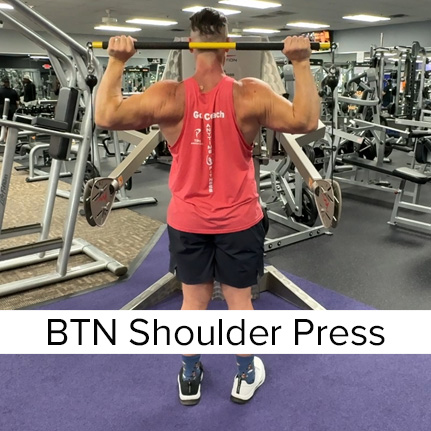
Behind-the-Neck Cable Shoulder Press
During the golf swing, the shoulders must move through substantial ranges while the torso rotates at high speed. Simply having strong shoulders isn't enough—the golfer needs strength that can be controlled through the available range of motion. That's what I particularly like about this exercise.
The behind-the-neck position increases the mobility requirement while the cables provide continuous resistance. When performed with an appropriate weight and good technique, it becomes less about building maximum pressing strength and more about developing strong, mobile, controlled shoulders that can support an athletic golf swing.
Recommended Programming
Golf performance training: 2–3 sets of 8–12 controlled repetitions
*I would generally use a lighter resistance than you would use for a traditional shoulder press. The goal here isn't to see how much weight you can press. The value of the exercise comes from controlling the larger mobility demand while maintaining good shoulder and trunk position.
Behind View
Behind-the-Neck Cable Shoulder Press Instructions
- Attach each end of the bar attachment to the two high cable connections.
- Stand centered between the cables with your feet approximately shoulder-width apart.
- Hold the bar with a comfortable wide grip.
- Begin with the arms extended overhead and the ribs and pelvis controlled.
- Slowly lower the bar behind the head toward the upper shoulder/trapezius area.
- Only lower as far as you can while maintaining a comfortable shoulder position and good posture.
- Pause briefly at the bottom without allowing the weight stack to rest.
- Press the bar upward until the arms are extended overhead.
- Keep the movement slow and controlled rather than using momentum.
- Repeat for the desired number of repetitions.
Front View
Side View
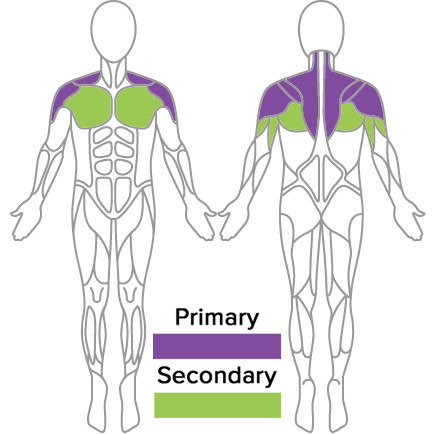
Primary Muscles Used
Tips
- Start Light: Use a lighter weight than you would for a traditional shoulder press because of the increased shoulder mobility required.
- Control the Stretch: Lower the bar slowly and allow the shoulders to move naturally into the increased range.
- Stay Tall: Maintain good posture throughout the entire movement.
- Brace the Core: Keep your abdominals engaged to prevent excessive arching of the lower back.
- Neutral Head: Keep your head and neck in a natural position rather than pushing your head forward.
- Smooth Tempo: Perform each repetition slowly and under control, especially during the lowering phase.
- Comfortable Grip: Use a grip width that allows the shoulders to move comfortably behind the head.
- Use Your Range: Only lower the bar as far as your current shoulder mobility comfortably allows.
- Keep It Even: Press evenly through both arms and keep the bar level.
- Quality First: Prioritize mobility, control, and technique over the amount of weight being lifted.
Important: Go Lighter on This Exercise
The behind-the-neck position places the shoulder into a more demanding combination of abduction and external rotation. For someone with good shoulder and thoracic mobility, that can make this a useful mobility-strength exercise.
But that additional range also means this is not the exercise to load aggressively.
Use enough resistance to challenge the shoulders while still allowing the bar to travel smoothly and comfortably. If adding weight causes the head to move forward, the ribs to flare, the lower back to arch excessively, or the shoulders to feel pinched or painful, the resistance is too heavy—or this variation may not be appropriate for that individual.
Who Should Be Careful With This Exercise?
This isn't necessarily the right shoulder press for every golfer.
Someone with limited shoulder external rotation, poor overhead mobility, significant thoracic restriction, or a history of shoulder problems may be better served initially with a traditional cable press, landmine press, or another overhead variation.
Never force the bar lower simply to create a bigger stretch. The range should be determined by the golfer's available mobility and ability to control that position.
Common Mistakes
- Too Much Weight: Heavy resistance can compromise shoulder position and defeat the purpose of using the increased range of motion.
- Forcing Depth: Don't force the bar lower than your shoulders can comfortably accommodate.
- Moving Too Fast: Allowing the cables to pull the bar quickly downward reduces control and increases stress on the shoulders.
- Head Forward: Avoid pushing or ducking the head forward as the bar travels behind it.
- Back Arching: Excessive lower-back extension often compensates for limited shoulder or thoracic mobility.
- Rib Flare: Keep the rib cage controlled instead of allowing it to lift as you press overhead.
- Using Momentum: Don't bounce out of the bottom or use your legs to help drive the bar upward.
- Uneven Press: Avoid allowing one arm to press faster or higher than the other.
- Excessive Shrugging: Let the shoulder blades move naturally without unnecessarily pulling the shoulders toward the ears.
- Ignoring Discomfort: A controlled stretch is fine; pinching or pain in the shoulder is a sign to reduce the range, decrease the weight, or stop the exercise.
Tim's list of benefits for the Behind-the-Neck Cable Shoulder Press
- Develops shoulder strength through an extended overhead range of motion.
- Challenges shoulder mobility more than a conventional front shoulder press.
- Strengthens the deltoids and upper back, helping create a strong, stable shoulder complex.
- Encourages thoracic extension and upper-back mobility, both important for achieving good golf posture and rotation.
- Improves overhead movement capacity, which can complement the large ranges of shoulder motion required during the golf swing.
- Builds core stability because the torso must remain controlled while the arms move overhead.
- Trains both arms simultaneously while the two independent cables require the golfer to control the bar evenly.
- Provides constant cable tension throughout the movement rather than relying solely on gravity.
- Challenges postural control, especially when performed standing.
- Can help expose left-to-right differences in shoulder mobility or control.
What if you could play the best golf of your life while looking and feeling your best? Green Physique's Golf Wellness program is an easy-to-use, expert-guided fitness program designed to help golfers of any skill level increase strength, mobility, stability, and flexibility.
Click here to go back to the full exercise list.