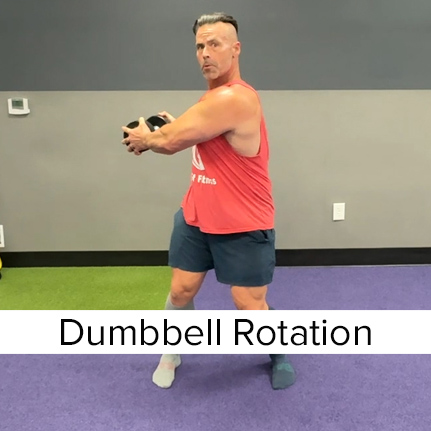
Standing Dumbbell Rotation
I think this exercise is particularly valuable because it trains something many golfers overlook: rotational acceleration and deceleration. Most golfers spend plenty of time trying to create more speed, but they rarely train the ability to control that speed. The best ball strikers aren't just fast—they're able to sequence, accelerate, and then decelerate efficiently after impact.
Recommended Programming
- Warm-Up/Activation: 2 sets of 10 rotations per side using a light dumbbell.
- Power Development: 3–4 sets of 6–8 explosive repetitions per side.
- Rotational Endurance: 2–3 sets of 10–12 repetitions per side.
- Speed Training: 3 sets of 5–6 fast, controlled repetitions per side using a lighter load.
Standing Dumbbell Rotation Instructions
- Stand with your feet approximately shoulder-width apart while holding a dumbbell with both hands at chest height.
- Slightly bend your knees, brace your core, and extend your arms.
- Using your abdominal muscles, rotate your torso and shoulders toward one side while allowing your hips to rotate naturally.
- Keep your arms extended throughout the movement.
- Rotate explosively back through the center toward the opposite side.
- Control the finish before reversing directions.
- Continue rotating smoothly from side to side while maintaining good posture.
Front View
Side View
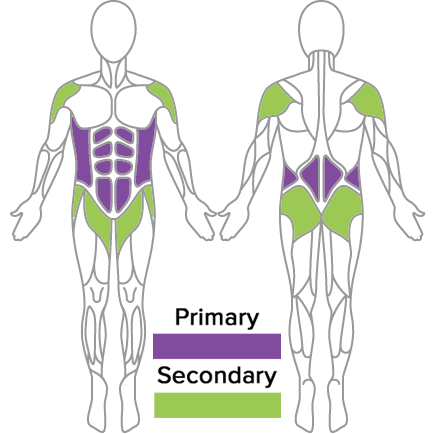
Primary Muscles Used
Tips
- Rotate your hips and shoulders together.
- Brace your core before each repetition.
- Drive the movement from your legs.
- Stay tall throughout the exercise.
- Accelerate smoothly through the middle of the rotation.
- Control the return rather than letting momentum take over.
- Keep your knees slightly bent.
- Maintain even pressure through both feet.
- Prioritize speed with control rather than heavy weight.
- Finish each repetition balanced and athletic.
Common Mistakes
- Rotating Only the Arms: Initiate the movement with your hips and torso instead of simply swinging the dumbbell with your arms.
- Keeping the Lower Body Completely Still: Allow your hips and feet to rotate naturally to create a fluid, athletic movement.
- Using Too Much Weight: Choose a weight that allows you to move quickly while maintaining excellent technique.
- Leaning Side to Side: Keep your spine tall and rotate around your body's center rather than shifting laterally.
- Twisting Through the Lower Back: Generate most of the rotation from your hips and thoracic spine while keeping the lumbar spine stable.
- Holding Your Breath: Exhale as you rotate and inhale as you return.
- Moving Too Fast Without Control: Accelerate the weight smoothly but always finish under control before changing directions.
- Allowing the Shoulders to Shrug: Keep your shoulders relaxed while maintaining good posture.
- Losing Balance: Maintain even pressure through both feet throughout every repetition.
- Stopping the Movement Abruptly: Decelerate the weight under control to improve stability and reduce stress on the joints.
Tim's list of benefits for the Standing Dumbbell Rotation
- Improves rotational power through the core.
- Develops proper sequencing from the lower body to the upper body.
- Enhances hip and thoracic spine mobility.
- Builds the ability to accelerate and decelerate rotational movements.
- Reinforces efficient weight transfer.
- Improves balance throughout the golf swing.
- Increases core endurance for maintaining posture late in the round.
- Helps generate greater clubhead speed through improved force transfer.
What if you could play the best golf of your life while looking and feeling your best? Green Physique's Golf Wellness program is an easy-to-use, expert-guided fitness program designed to help golfers of any skill level increase strength, mobility, stability, and flexibility.
Sign Up Today!
Click here to go back to the full exercise list.