

Walk into almost any supplement store and you’ll find an entire section devoted to magnesium. Magnesium glycinate, citrate, malate, oxide, threonate, chloride, taurate… the list can become confusing very quickly.
They all contain magnesium, so does the form really matter?
Yes, but perhaps not quite as much as supplement marketing would have you believe.
Magnesium is an essential mineral involved in hundreds of biochemical processes throughout the body. It contributes to normal muscle and nerve function, energy production, protein synthesis, blood glucose regulation, blood pressure regulation, bone health, and the production of DNA. According to the National Institutes of Health, approximately 30–40% of the magnesium we consume through food is typically absorbed.
For golfers and active people in general, those functions should immediately get our attention.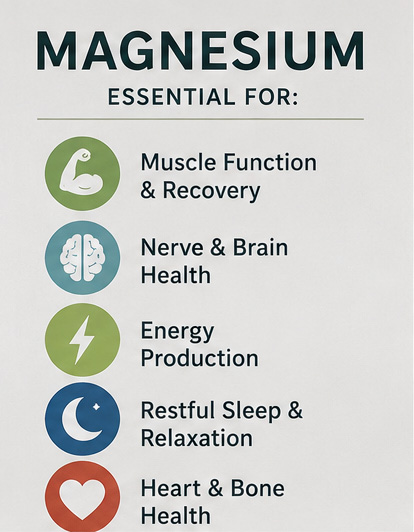
A golf swing requires muscular contraction and relaxation, coordination, neurological control, energy production, and repeated physical effort. Then we need our bodies to recover so we can train and play again. Magnesium isn’t a magic golf-performance supplement, but it is part of the nutritional foundation that allows those systems to function normally.
And as I frequently say in The Holistic Golfer, getting the fundamentals right is usually more important than chasing the newest supplement.
Magnesium Should Start With Food
My preference is always to obtain nutrients from whole foods whenever possible.
Fortunately, there are plenty of excellent natural sources of magnesium, including:
- Pumpkin seeds and other seeds
- Almonds, cashews and other nuts
- Spinach and dark leafy greens
- Beans and lentils
- Whole grains
- Avocados
- Dark chocolate and cacao
- Certain fish
Magnesium is particularly common in plant foods including leafy vegetables, legumes, nuts, seeds and whole grains.
A diet built around real, minimally processed foods therefore accomplishes far more than simply providing magnesium. Those foods deliver fiber, phytonutrients, healthy fats, vitamins, minerals and many other compounds working together.
But there are situations where supplementation can make sense, and that’s where choosing the correct form becomes important.
Not All Magnesium Supplements Are the Same
When you see “magnesium” on a supplement bottle, the magnesium has been bound to another compound. That compound affects characteristics including solubility, gastrointestinal tolerance and how well the magnesium is absorbed.
Research has repeatedly demonstrated differences among magnesium preparations. Magnesium citrate, for example, has shown greater bioavailability than magnesium oxide in human studies.
Here’s a practical overview:
| Magnesium Form | Relative Absorption | Common Reason for Choosing It | GI Considerations | Holistic Golfer Take |
|---|---|---|---|---|
| Magnesium glycinate / bisglycinate | Very good | General supplementation, relaxation and nighttime use | Usually gentle | Excellent all-around choice |
| Magnesium citrate | Very good | General magnesium supplementation; constipation | Can loosen stools | One of my favorites |
| Magnesium chloride | Good | General magnesium replacement | May cause GI symptoms at larger doses | Good bioavailability |
| Magnesium lactate | Good | General supplementation | Generally well tolerated | Good but less commonly used |
| Magnesium malate | Good | General supplementation; commonly marketed for muscle/energy support | Usually well tolerated | Good option, but don’t overstate the special claims |
| Magnesium L-threonate | Good/specialized | Primarily marketed for brain and cognitive health | Usually gentle | Very interesting, but more expensive and still being researched |
| Magnesium taurate | Likely good | Often marketed for cardiovascular support | Usually gentle | Interesting, but less clinical evidence |
| Magnesium gluconate | Good | General supplementation | Generally reasonable | Solid but less common |
| Magnesium oxide | Relatively poor | Inexpensive; constipation/antacid applications | More likely to have a laxative effect | Not my first choice for magnesium replacement |
| Magnesium hydroxide | Limited | Primarily laxative/antacid use | Significant laxative potential | Not my choice for routine supplementation |
| Magnesium sulfate | Limited for routine oral use | Better known as Epsom salt; specialized medical applications | Strong GI effect orally | Not a routine daily supplement |
| Magnesium carbonate | Moderate | General supplementation/antacid preparations | Variable | Acceptable, but rarely my first choice |
The NIH specifically identifies magnesium citrate, chloride, lactate and aspartate among forms that are more easily absorbed than some alternatives.
My First Choice: Magnesium Glycinate
For someone simply looking for a high-quality daily magnesium supplement, magnesium glycinate or bisglycinate is probably where I would start.
Magnesium is attached to the amino acid glycine, and this form tends to be well tolerated. Research on magnesium diglycinate has demonstrated useful absorption characteristics, although we shouldn’t assume that every claim made for glycinate has been conclusively proven.
You’ll frequently hear magnesium glycinate called the “sleep magnesium.” I think we need to be a little careful with that label.
Magnesium itself plays important roles in nervous-system function, and research has investigated magnesium supplementation for sleep. But saying that glycinate is definitively superior to every other form specifically for sleep goes beyond the available evidence.
Still, because it combines good absorption with generally good gastrointestinal tolerance, glycinate is an excellent practical choice.
Magnesium Citrate: Another Excellent Option
Magnesium citrate may have some of the strongest evidence behind its absorption.
Studies comparing citrate with magnesium oxide have demonstrated superior bioavailability of citrate.
Citrate does have one important characteristic: it can draw water into the intestines.
That means someone who is taking magnesium and also tends toward constipation may actually benefit from citrate’s GI effect. Someone who already has loose stools may prefer glycinate instead.
For a golfer who asks me, “What’s a well-absorbed magnesium without spending a fortune?” citrate would be very high on my list.
What About Magnesium L-Threonate and the Brain?
This might be the most interesting form of magnesium currently receiving attention.
Magnesium L-threonate is frequently marketed as the “brain magnesium.” Human clinical trials have reported potential improvements in certain measures of cognition and sleep, including recent randomized controlled research.
That’s interesting—especially for golfers.
Golf isn’t simply a physical sport. Concentration, emotional regulation, decision-making and the ability to remain present for several hours can be every bit as important as strength and mobility.
But I would not jump from “interesting research” to “every golfer needs magnesium L-threonate.”
It tends to be considerably more expensive, and the scientific literature is still developing. Other clinical research has not found benefits for every outcome studied.
For now, I consider L-threonate a promising specialty form rather than the obvious magnesium choice for everyone.
One Form I Usually Don’t Choose: Magnesium Oxide
Magnesium oxide is common because it is inexpensive and contains a relatively high percentage of elemental magnesium by weight.
The problem is that the amount printed on a bottle isn’t very useful if much less of it becomes available to the body.
Magnesium oxide has consistently demonstrated poorer bioavailability than forms such as citrate, and its lower solubility appears to be part of the reason.
That doesn’t make magnesium oxide useless. Its effects in the intestine can actually be desirable when magnesium is being used for constipation.
But if my primary goal is improving magnesium intake, I would generally choose another form.
Don’t Be Fooled by the Number on the Bottle
This is one of the most important parts of shopping for magnesium.
A supplement might advertise:
“2,000 mg Magnesium Glycinate”
That does not necessarily mean you’re consuming 2,000 mg of magnesium.
Magnesium glycinate is a compound containing magnesium plus glycine. What matters nutritionally is how much elemental magnesium that compound actually provides.
Look at the Supplement Facts panel and find the line that says:
Magnesium — ___ mg
That’s the number I care about.
It’s another reason I prefer evaluating supplements based on what is actually inside them instead of relying on the marketing on the front of the bottle.
What About Magnesium, Zinc and B6 for Testosterone?
Another combination that has received a great deal of attention in the athletic world is magnesium taken with zinc and vitamin B6, commonly known as ZMA.
Part of the popularity of ZMA came from early research in strength-trained athletes suggesting that supplementation could increase testosterone and potentially improve strength. That sounds impressive, but subsequent research has not consistently reproduced those testosterone increases.
So is the idea completely wrong?
 Not necessarily but I think the explanation is more nuanced.
Both magnesium and zinc are essential nutrients involved in normal hormonal and metabolic function. Zinc in particular appears to have an important relationship with testosterone. Research suggests that zinc deficiency may contribute to lower testosterone concentrations and that correcting zinc deficiency can help restore normal levels.
That is very different from saying that taking extra zinc will continually increase testosterone in someone who already has adequate zinc status.
Magnesium may have a similar relationship. Adequate magnesium supports normal physiological and hormonal function, and there is research investigating its relationship with testosterone, particularly in physically active individuals.
Vitamin B6 also participates in numerous aspects of protein metabolism, neurotransmitter production and normal physiological function, but there is currently little convincing evidence that adding B6 to magnesium and zinc creates a special testosterone-boosting effect.
The Holistic Golfer Perspective
I actually think this is a perfect example of the difference between supporting normal physiology and trying to artificially “boost” something.
If you’re deficient in magnesium or zinc, correcting that deficiency may improve the environment in which your body naturally produces hormones, including testosterone.
If you’re already getting enough, taking substantially more doesn’t necessarily mean more testosterone.
For golfers interested in maintaining healthy testosterone naturally, I would put far more emphasis on the fundamentals:
- Adequate magnesium and zinc from nutrient-dense foods
- Resistance and strength training
- Consistent, high-quality sleep
- Adequate protein and total calories
- Healthy body composition
- Managing excessive stress
- Avoiding nutritional deficiencies
A magnesium, zinc and B6 supplement may be useful when it helps fill genuine nutritional gaps, but I wouldn’t consider it a magic testosterone supplement.
The goal isn’t to force the body to produce more testosterone. The goal is to give the body everything it needs to produce and regulate hormones the way it was designed to.
The Holistic Golfer’s Natural Electrolyte Drink
If I’m going to talk about hydration, magnesium and muscle cramps, I also want to give you something practical you can actually take onto the golf course.
I’m a big believer that hydration doesn’t have to mean reaching for a brightly colored sports drink filled with artificial flavors, dyes and unnecessary ingredients.
We can make a very effective electrolyte drink ourselves.
The Holistic Golfer Electrolyte Mix
For approximately 32 ounces:
- 16 oz pure coconut water
- 16 oz filtered water
- Juice of ½–1 organic lemon or lime
- ¼ teaspoon sea salt
- 100–150 mg supplemental magnesium
- Optional: 100–200 mg additional potassium
- Optional: 1–2 teaspoons raw honey
Shake everything together and keep it cold.
For a long workout or an 18-hole round, particularly in hot weather, I would sip it gradually rather than drinking the entire bottle at once.
Why Coconut Water?
Coconut water gives us something plain water doesn’t naturally provide in significant amounts: electrolytes, particularly potassium.
It also provides some magnesium and carbohydrate while giving the drink a naturally pleasant flavor without requiring artificial sweeteners.
I like using approximately half coconut water and half regular water because we’re not trying to turn this into a sugary beverage. We’re simply using a whole-food source to provide part of our electrolyte base.
Sea Salt: Don’t Be Afraid of Sodium When You’re Sweating
Sodium sometimes gets unfairly treated as something we should always avoid.
Context matters.
When we’re exercising and sweating, especially while walking a golf course for four or five hours in hot weather we’re losing sodium through our sweat.
That’s why I add a small amount of sea salt.
A quarter teaspoon of salt generally provides roughly 500–600 mg of sodium, depending on the type and brand of salt. That’s a much more meaningful amount for exercise hydration than simply adding a tiny decorative “pinch.”
For someone who is an especially heavy or salty sweater, electrolyte requirements can be considerably higher and should be individualized.
Potassium: Let the Coconut Do Most of the Work
This is where coconut water really shines.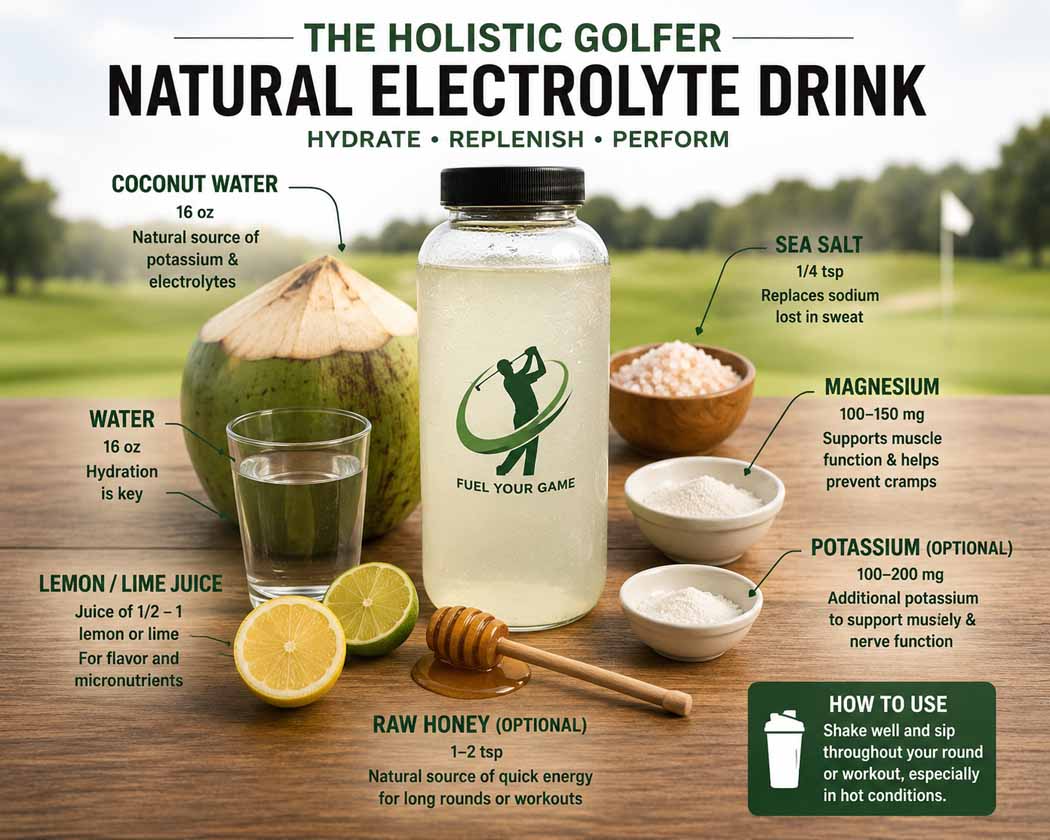
Instead of dumping a large amount of supplemental potassium into the drink, I prefer getting most of it naturally from coconut water.
Depending on the brand, 16 ounces of coconut water can provide several hundred milligrams of potassium.
If someone needs more potassium overall, I’d rather first look at their diet; potatoes, avocados, bananas, beans, leafy greens and other potassium-rich whole foods than automatically start adding large quantities of supplemental potassium.
If additional potassium is used in an electrolyte mix, I would keep the amount modest.
Magnesium: A Little Goes a Long Way
Since this entire article is about magnesium, naturally we’re going to include it.
But this is another case where more isn’t necessarily better.
I would aim for approximately 100–150 mg of elemental magnesium in the entire 32-ounce drink.
Magnesium citrate can work well in a beverage because of its solubility, although too much may have a laxative effect which is obviously the last thing we want halfway through the back nine.
Magnesium glycinate is another option when gastrointestinal tolerance is the priority.
Remember that we’re looking for the amount of elemental magnesium, not simply the total weight of the magnesium compound listed on the front of a supplement package.
Lemon or Lime
Fresh lemon or lime isn’t primarily there because we need it for electrolytes.
It’s there because it tastes good and gives us a small amount of naturally occurring nutrients and plant compounds.
More importantly, it makes the drink enjoyable enough that you’ll actually want to drink it throughout your round.
And that matters.
What About Honey?
For a normal short workout, you probably don’t need it.
For several hours of golf, however, a small amount of carbohydrate can make more sense.
One or two teaspoons of raw honey adds a modest amount of easily available carbohydrate without turning the drink into a sugar bomb.
Remember that we’re not trying to eliminate carbohydrates during exercise. During prolonged activity, carbohydrates can be useful fuel.
That’s very different from mindlessly drinking a high-sugar beverage while sitting at a desk.
Think of It as a Hydration System, Not a Magic Drink
The purpose of this drink isn’t to “cure” muscle cramps.
It’s to give the body some of the things it needs while you’re asking it to perform:
Water → Hydration
Sodium → Replaces an important electrolyte lost through sweat
Coconut water → Potassium + naturally occurring electrolytes
Magnesium → Supports normal muscle and nerve function
Lemon/lime → Flavor + whole-food plant compounds
Honey → Optional carbohydrate for longer-duration activity
That’s a very different philosophy from believing that more electrolytes automatically equal better performance.
For most golfers, the goal is simply to replace what we’re losing at a reasonable rate while continuing to fuel and hydrate the body throughout the round.
And remember, this drink doesn’t replace good nutrition.
Eat magnesium- and potassium-rich foods. Hydrate before you get to the golf course. Eat a nutrient-dense meal before you play. Continue drinking during your round.
Then use something like this electrolyte drink to support the foundation you’ve already built.
That’s the Holistic Golfer approach:
Real food first. Hydration with a purpose. Supplements when they make sense. And nothing added simply because a marketing department tells us we need it.
The Holistic Golfer Bottom Line
Magnesium isn’t exciting because it’s a new supplement.
It’s exciting because it’s an essential nutrient that the human body genuinely needs.
For golfers, adequate magnesium supports many of the physiological systems we’re constantly asking to perform: muscles, nerves, energy metabolism, recovery and normal cardiovascular function.
My approach would be simple:
Start with food.
Build your diet around vegetables, leafy greens, nuts, seeds, legumes, whole grains and other nutrient-dense foods.
Then, if supplementation makes sense, choose the supplement intelligently.
For most people looking for a general magnesium supplement, magnesium glycinate/bisglycinate would probably be my first choice, with magnesium citrate close behind. If constipation is an issue, citrate becomes especially interesting. And if someone is specifically interested in emerging research on cognition and sleep, magnesium L-threonate may be worth discussing—but I wouldn’t automatically pay the premium simply because the marketing sounds impressive.
That’s really what The Holistic Golfer philosophy is about.
We don’t need to be anti-supplement.
We also don’t need to chase every new supplement.
Use whole foods as the foundation, use science to separate evidence from marketing, and use supplements strategically when they can genuinely add something to the foundation you’ve already built.
Research Library & Further Reading
Why These References?
As The Holistic Golfer, I don’t want to simply tell you that something works because it’s natural, popular, or something I personally use.
Whenever possible, the information in these articles is built around peer-reviewed scientific research, systematic reviews, randomized controlled trials, position statements, and respected scientific and government health resources.
That doesn’t mean science always gives us a perfect answer. Nutrition and human performance are complicated, research continues to evolve, and individual responses can vary.
My goal is to combine the best available scientific evidence with practical experience, whole-food nutrition, and a holistic approach to health and performance.
Don’t just take my word for it. I encourage you to explore the research below and make informed decisions about your own health.
Last reviewed and updated: August 2026
Research Library & Further Reading
1. NIH Office of Dietary Supplements — Magnesium: Health Professional Fact Sheet
Probably our best foundational reference. Covers magnesium requirements, food sources, deficiency, absorption, supplementation, safety, and interactions.
NIH Magnesium Fact Sheet
2. Lindberg et al. — Magnesium Bioavailability From Magnesium Citrate and Magnesium Oxide
Journal of the American College of Nutrition. A controlled human study showing magnesium citrate was more soluble and bioavailable than magnesium oxide.
View the study on PubMed
3. Walker et al. — Magnesium Citrate Compared With Amino-Acid Chelate and Magnesium Oxide
A randomized, double-blind study comparing different forms. Citrate demonstrated better bioavailability than magnesium oxide.
View the study on PubMed
4. Werner et al. — Assessment of Bioavailability of Magnesium Citrate and Magnesium Oxide
A later controlled study that again found greater bioavailability from magnesium citrate compared with magnesium oxide.
View the study on PubMed
5. Firoz & Graber — Bioavailability of U.S. Commercial Magnesium Preparations
Useful for our magnesium comparison chart. Magnesium oxide showed relatively poor absorption, while magnesium chloride, lactate, and aspartate demonstrated better bioavailability.
View the study on PubMed
6. Magnesium L-Threonate, Cognition and Sleep — Randomized Controlled Trial
A recent double-blind, placebo-controlled trial found improvements in some measures of cognition, memory, reaction time, and subjective sleep-related impairment, although not all sleep outcomes improved. This is a good reference for why we described L-threonate as interesting and promising rather than definitively superior.
View the L-threonate study on PubMed
7. NIH Office of Dietary Supplements — Potassium
Useful for the cramping/electrolyte section. Potassium is essential for maintaining cellular fluid balance and the electrical gradients required for normal nerve transmission and muscle contraction.
NIH Potassium Fact Sheet
8. Coconut Water and Exercise Rehydration
A crossover study in exercise-trained men compared coconut water, water, and a carbohydrate-electrolyte sports drink after dehydrating exercise. All successfully supported rehydration, with no significant performance differences among them. That’s a useful reference for our natural electrolyte drink without pretending coconut water is magically superior.
View the coconut-water study on PubMed